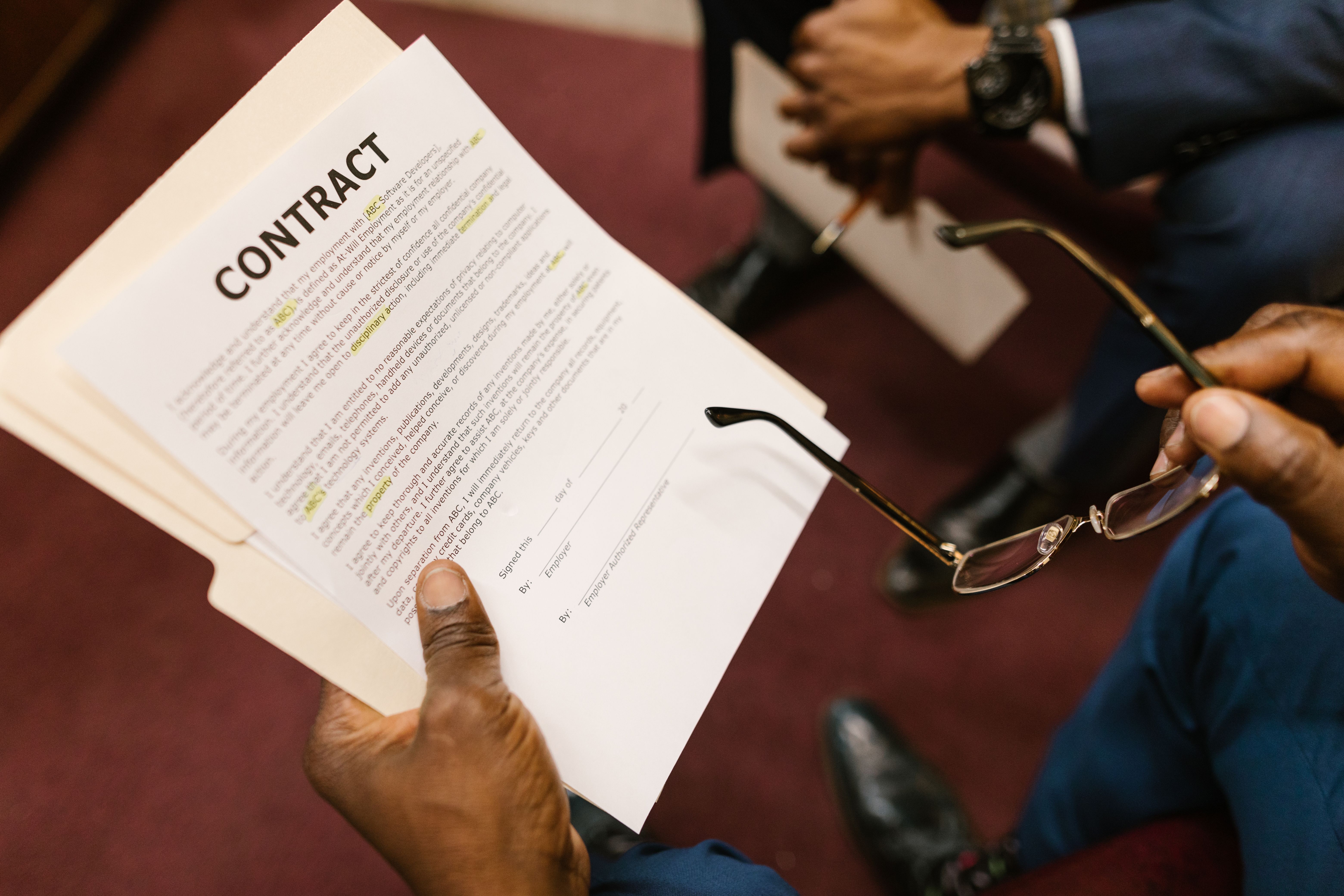
In commercial debt recovery, the success or failure of a collection action is rarely decided in a courtroom post-default. It is decided at the signing table before a single dollar ever leaves the funder's bank account.
When a merchant defaults, standard collection agencies attempt to recover capital through phone calls, demand letters, and administrative pressure. However, when dealing with bad-faith actors, intentional revenue diversion, or high-risk accounts, informal collection tactics quickly hit a wall. To achieve actual financial recovery, an MCA attorney must transform the initial commercial agreement into an actionable legal instrument that enables swift post-default enforcement.
By embedding four specific, high-leverage contract clauses into the foundational agreement, MCA funders can establish immediate legal leverage, eliminate procedural hurdles, and drastically accelerate capital recovery after a default.
Key Takeaways
- Recovery Begins at Contract Execution: Waiting until a default occurs to consider collection remedies limits your options; enforceable legal leverage must be engineered directly into the foundational agreement.
- Clear Terms Eliminate Judicial Friction: Explicit clauses defining jurisdiction, percentage-based legal fees, and financial reporting covenants eliminate unnecessary motion practice and accelerate the entry of enforceable money judgments.
- UCC Mechanics Provide Direct Enforcement: Contractual authority under UCC § 9-607 enables funders to intercept processor payouts and collect directly from account debtors without waiting months for trial outcomes.
Clause 1: Forum Selection and Exclusive Jurisdiction (Locking in New York/Local Courts)
When a merchant located in Texas or California defaults on a New York-based MCA funder, forcing the funder to litigate across multiple foreign state courts adds substantial delay, expense, and legal friction.
A well-drafted forum selection clause establishes exclusive jurisdiction in the funder’s home state court system (such as New York State Supreme Court or New York County Civil Court) and includes an explicit waiver of forum non conveniens (inconvenient forum defenses).
"Jurisdiction and Venue: Merchant and Guarantor(s) expressly and irrevocably agree that any legal suit, action, or proceeding arising out of or relating to this Agreement shall be instituted exclusively in the Supreme Court of the State of New York, County of New York, or the Civil Court of the City of New York. Merchant and Guarantor(s) waive any objection based on improper venue or forum non conveniens."
The Collection Impact
- Eliminates Out-of-State Motion Practice: Prevents defaulting merchants from delaying litigation by filing procedural motions to transfer venue to their home jurisdiction.
- Centralizes Legal Operations: Allows a funder’s litigation team to handle all enforcement actions through familiar local court procedures, minimizing legal overhead.
- Accelerates Entry of Money Judgments: Speeds up the timeline for obtaining an enforceable local judgment that can subsequently be domesticated out of state under the Uniform Enforcement of Foreign Judgments Act (UEFJA).
Clause 2: Enforceable Percentage-Based Legal Fee and Cost-Shifting Provisions
In standard breach-of-contract litigation, parties typically pay their own legal fees unless an explicit statutory or contractual exception exists. Furthermore, generic boilerplate clauses stating that the funder may recover "reasonable attorney's fees" invite judicial scrutiny, forcing litigation attorneys to submit itemized billing records subject to arbitrary reductions under the judicial "lodestar" calculation method.
To protect recovery margins, the contract must include an explicit, percentage-based attorney’s fee clause (typically 20% to 33% of the outstanding balance) alongside broad cost-shifting terms.
"Attorney's Fees and Enforcement Costs: Upon an Event of Default, Merchant and Guarantor(s) shall be jointly and severally liable for all costs and expenses incurred by Funder in enforcing its rights under this Agreement, including, without limitation, court costs, filing fees, service of process fees, asset-tracing expenses, and an attorney's fee equal to twenty-five percent (25%) of the total outstanding balance owed at the time of default, which the parties expressly agree is reasonable."
The Collection Impact
- Protects Net Capital Recovery: Ensures that legal expenses, court fees, and collection costs do not consume the principal balance being recovered.
- Increases Merchant Settlement Leverage: Increases the merchant’s total legal liability instantly upon breach, compelling principals to negotiate a structured workout or settlement early in the pre-suit demand stage.
- Bypasses Protracted Fee Hearings: Provides courts with a clear mathematical benchmark for awarding fees directly in motion for summary judgment orders or default judgments.
Clause 3: Mandatory Financial Disclosure and Post-Default Accounting Covenants
When a merchant stops remitting daily receipts, the immediate collection priority is identifying active bank accounts, secondary processing streams, and uncollected accounts receivable. Standard discovery procedures during formal litigation can take months to produce these financial records.
Embedding affirmative, time-sensitive financial disclosure covenants directly into the agreement compels the merchant and personal guarantor to supply balance sheets, tax filings, credit card processing reports, and active bank statements within 48 to 72 hours of a default notice.
"Post-Default Financial Reporting Covenant: Within forty-eight (48) hours of receiving a Notice of Default, Merchant and Guarantor(s) shall provide Funder with: (i) complete, unredacted bank statements for all active depository accounts held by Merchant or Guarantor for the preceding ninety (90) days; (ii) a complete list of all active credit card payment processors and processor IDs; and (iii) an itemized accounts receivable aging report. Failure to timely provide these records constitutes an independent material breach and per se evidence of intentional asset impairment."
The Collection Impact
- Provides Immediate Asset Targets: Delivers precise bank account numbers and merchant account identification numbers necessary to issue targeted restraining notices and bank levies immediately upon judgment entry.
- Lays the Groundwork for Subpoenas: Establishes clear contractual duties that support emergency court applications, post-judgment subpoenas, and orders to show cause if the merchant conceals financial records.
- Exposes Fraudulent Transfers: Helps post-judgment enforcement attorneys quickly identify whether daily receipts were unlawfully diverted into secondary or personal accounts.
Clause 4: Pre-Authorized UCC § 9-607 Collection Rights and Account Interception
Because a legitimate MCA transaction involves the purchase of future receipts and accounts receivable, the agreement should grant the funder explicit authorization under Article 9 of the Uniform Commercial Code (UCC), specifically UCC § 9-607, to directly notify account debtors, credit card processors, and bank institutions upon default.
A robust collection-focused contract explicitly designates the funder as the merchant's attorney-in-fact to issue direct payment directives to processors and account debtors.
"Direct Enforcement Under UCC § 9-607: Upon the occurrence of an Event of Default, Funder shall have the immediate right, without prior notice or judicial order, to exercise its rights under UCC § 9-607. Merchant irrevocably appoints Funder as its attorney-in-fact to issue direct payment instructions to any credit card processor, account debtor, bank, or third-party payor holding or processing Merchant's receivables, instructing them to direct all current and future payments to Funder until the obligation is satisfied."
The Collection Impact
- Bypasses Lengthy Lawsuits: Allows the funder to enforce security interests and collect directly from the merchant's income sources without waiting for a full civil trial to conclude.
- Freezes Credit Card Processor Payouts: Gives credit card payment processors clean, contractual authority to route daily settlement funds directly to the funder upon receiving a formal default notice.
- Establishes Priority Over Subsequent Stackers: Establishes clear notice under UCC filing rules, allowing the funder to assert primary entitlement to receivables over lower-priority secondary funders.
Stop Chasing Defaulted Merchants, Start Recovering Capital
Every day a defaulted merchant delays, your recovery odds shrink. Standard collection agencies send reminders; David I. Mizrahi Law, P.C. delivers the legal muscle needed to freeze assets, enforce UCC rights, and secure court judgments.
Protect your yield and hold bad-faith merchants accountable. Speak directly with an experienced MCA collections attorney to initiate swift legal recovery.
Frequently Asked Questions
1. Why is a percentage-based attorney’s fee clause better than a standard "reasonable fee" clause?
A "reasonable fee" clause leaves the legal fee amount to the judge's discretion, requiring attorneys to submit detailed billing logs that are frequently reduced by the court. A clear, pre-agreed percentage clause (e.g., 25%) establishes a definitive contract value that courts can award directly in summary or default judgments.
2. How does a forum selection clause protect an MCA funder operating nationally?
A forum selection clause ensures that regardless of where the merchant or personal guarantor is located, all legal proceedings take place in the funder's local court system. This eliminates the expense, delay, and complexity of hiring out-of-state counsel to file original lawsuits across multiple foreign jurisdictions.
3. What is the difference between filing a UCC-1 financing statement and exercising rights under UCC § 9-607?
Filing a UCC-1 financing statement perfects your security interest and gives public notice of your lien on receivables. Exercising rights under UCC § 9-607 is the actual enforcement step where you instruct third-party payors, account debtors, or credit card processors to redirect payments directly to you to satisfy the defaulted debt.
4. Can an attorney’s fee clause be enforced if the merchant files for bankruptcy?
If the underlying contract contains an enforceable fee-shifting provision, post-petition legal fees and collection expenses can often be added to the funder's overall proof of claim in bankruptcy court, depending on the perfection status of the collateral and the debtor's equity.
5. Why should an MCA funder consult a collection attorney to audit their contracts?
Commercial finance regulations, court precedent regarding usury defenses, and judgment enforcement rules evolve continuously. An MCA collection attorney ensures that template agreements remain enforceable, protect true-sale status, and contain the procedural tools necessary to execute rapid asset recovery after a breach.